
Introduction: Specification Discipline in Nonwoven Bag Procurement
Most quality disputes in custom bag orders do not originate on the production floor. They originate in the purchase order. A buyer who specifies "80gsm nonwoven tote with logo" has defined perhaps 30% of what determines the finished product. The remaining 70%—gusset geometry, handle attachment method, seam technology, ink system, surface finish—is left to the supplier's interpretation, and interpretation varies across factories. This guide sets out the complete specification framework our engineering team uses when scoping custom nonwoven bags for retail chains, food service distributors, and promotional buyers. Each section identifies the decision to be made, the parameters involved, and the documentation that should accompany it.
1. Define the Application Before Any Technical Parameter
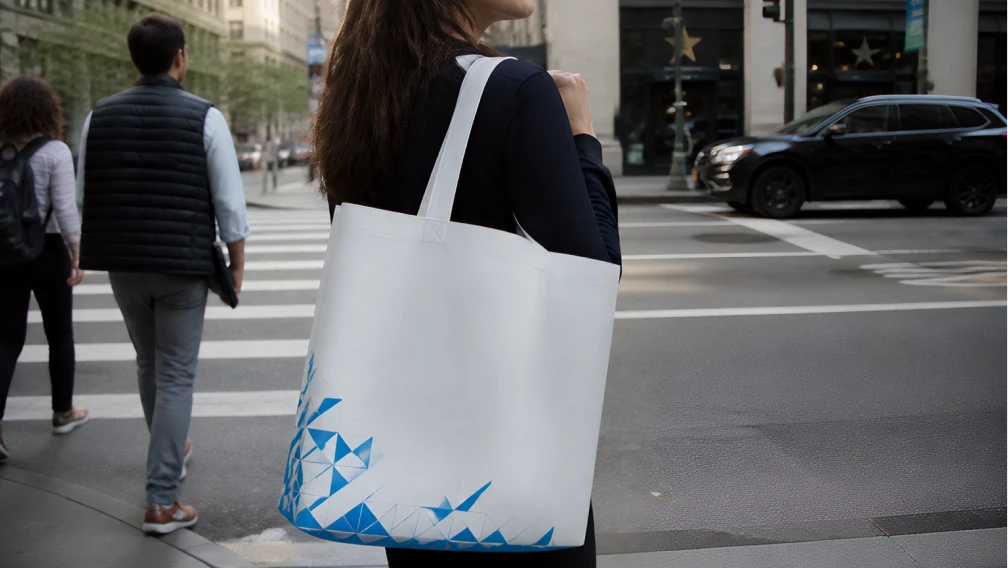
Every specification decision downstream depends on one upstream question: what will this bag actually do in the field? A checkout bag in a supermarket carries 8–12 kg of cans and bottles several times a week. A trade show giveaway carries a brochure and a water bottle once. A wine carrier must isolate glass bottles and survive point impacts. These are different engineering problems, and they price differently.
Document three inputs before requesting quotations:
- Load profile. Typical contents, maximum weight, and whether loads are static (shelved product) or dynamic (carried by a walking customer).
- Reuse expectation. Single-event distribution or a multi-year reusable retail program. Reuse count drives fabric weight and seam selection.
- Regulatory context. Many jurisdictions that restrict single-use plastic bags set durability expectations for reusable substitutes. Confirm the rules in your destination market before locking the spec.
With these inputs fixed, fabric weight, construction, and printing become engineering selections rather than guesses.
2. Fabric Weight: GSM Calibration by Load Profile
GSM (grams per square meter) is the primary density metric of PP spunbond nonwoven fabric. It correlates directly with tensile strength, tear resistance, hand feel, and unit cost. Under-specifying GSM is the most common cause of field failure in reusable bags; over-specifying it wastes resin and freight budget.
The following baseline reflects what we run in production for B2B programs:
| Application | Recommended GSM | Typical Load |
|---|---|---|
| Event giveaways, document carriers | 60–70 | Up to 3 kg |
| Standard retail and pharmacy bags | 70–80 | 3–6 kg |
| Grocery and supermarket reusable totes | 80–100 | 8–12 kg |
| Bottle carriers, hardware, premium retail | 100–120 | 12–15 kg |
| Laminated constructions | 90–120 base + film | Adds rigidity and barrier |
Two qualifications matter here. First, GSM alone does not guarantee strength: fiber drafting and thermal calendering during extrusion determine how that mass translates into tensile performance, which is why identical nominal GSM from different mills behaves differently. Second, lamination adds stiffness, so a laminated 90gsm construction can outperform a plain 110gsm bag in shape retention. When in doubt, request physical samples at two adjacent weights and load-test them with your actual product.
3. Bag Architecture: Style, Gussets, and Dimensions
Bag style determines both function and converting cost. The principal constructions:
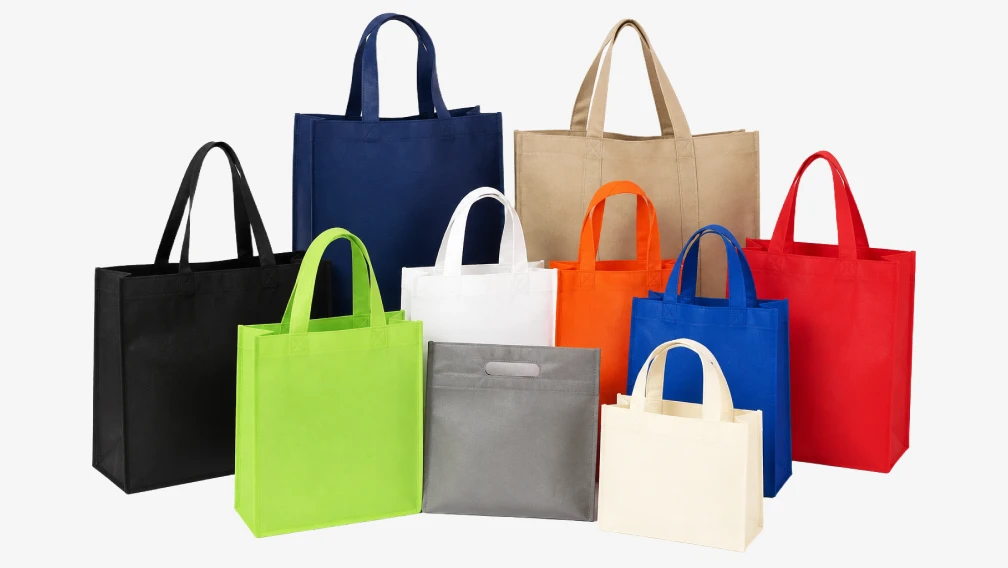
- D-cut bags. Die-cut handle punched directly into the bag body. Lowest converting cost, suited to light retail and promotional loads. No separate handle material.
- T-shirt (vest) bags. High-throughput checkout format familiar from grocery retail. Fast to pack, economical at volume.
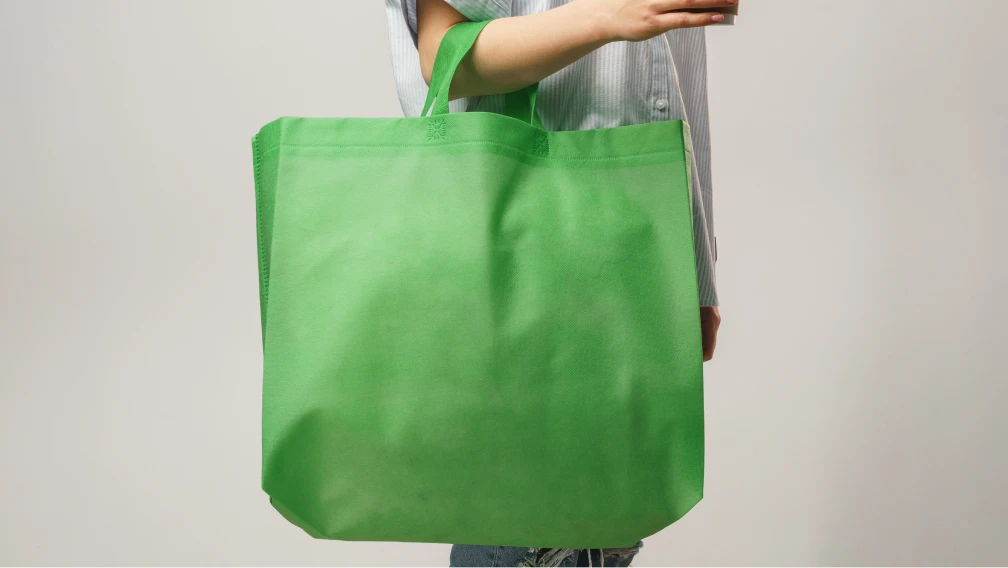
- Sewn or welded handle bags. Separate webbing or self-fabric handles attached to the body. Required for loads above roughly 6 kg.
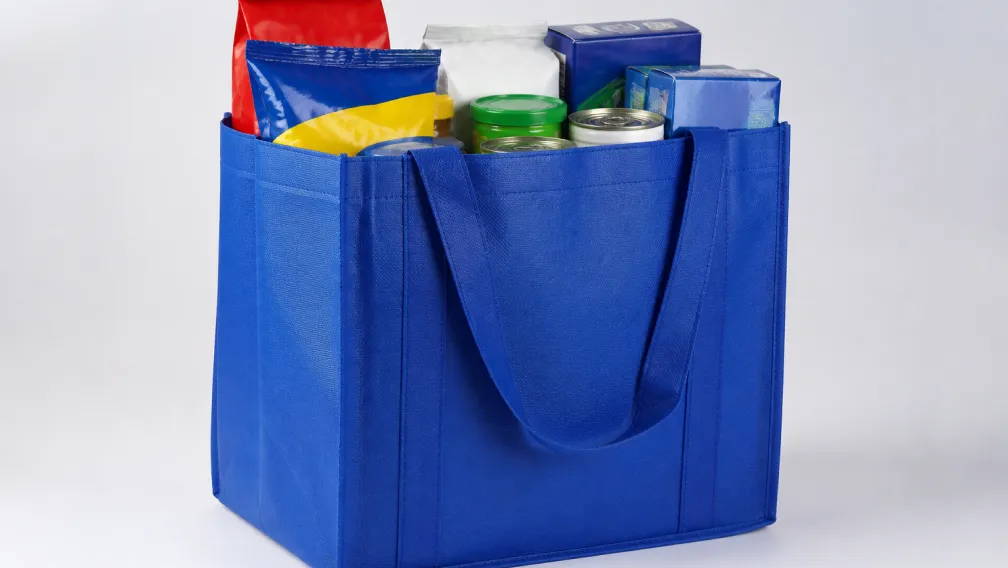
- Box bags. Full side and bottom gussets produce a self-standing rectangular form for groceries, catering, and boxed goods.
- Wine and bottle bags. Divided compartments, base inserts, and wrap-under handle webbing for point-loaded glass.
- Specialty closures. Drawstring, zipper, and foldable formats serve promotional, dust-cover, and e-commerce niches.
Dimension specification should state width, height, and gusset depth in millimeters, measured flat. A frequent sourcing error is quoting only two dimensions; without gusset depth, two suppliers will quote two different bags at two different prices, and the cheaper one usually removed the gusset.
4. Handles and Seam Construction
Field failures concentrate at the handle attachment. Specify the attachment method explicitly:
- Ultrasonic welding fuses fabric layers at 20 kHz without thread, producing a clean, fast, low-cost seam. Appropriate for loads up to roughly 8–10 kg on 80gsm+ substrate.
- Mechanical stitching with high-tensile polyester thread remains the specification for heavier duty. At handle junctions, an X-box stitch pattern distributes pull force across a wider fabric area than a straight bartack.
- Wrap-under webbing routes the handle strap beneath the bag base, transferring load to the strap itself rather than to the fabric. This is the correct construction for bottle carriers and loads above 12 kg.
If your order is load-critical, state a target dynamic load rating in the PO—for example, "no seam failure at 12 kg carried load"—and ask the factory to verify by destructive sample testing. For a deeper treatment of seam engineering, see our analysis of high-capacity PP nonwoven bag construction.
5. Printing Method Selection
Printing method is a function of artwork complexity, order volume, and substrate finish. The decision matrix we apply:
| Method | Artwork Fit | Volume Fit | Notes |
|---|---|---|---|
| Silkscreen | 1–4 spot colors, bold logos | Small to mid runs | Low setup cost; ink sits on surface |
| Heat transfer | Multi-color detail, small coverage | Small runs | Sharp detail; lower abrasion resistance |
| Rotogravure (on BOPP, laminated) | Full CMYK, photographic, Pantone-critical | Large runs | Cylinder setup cost amortizes at scale; print sealed under film |
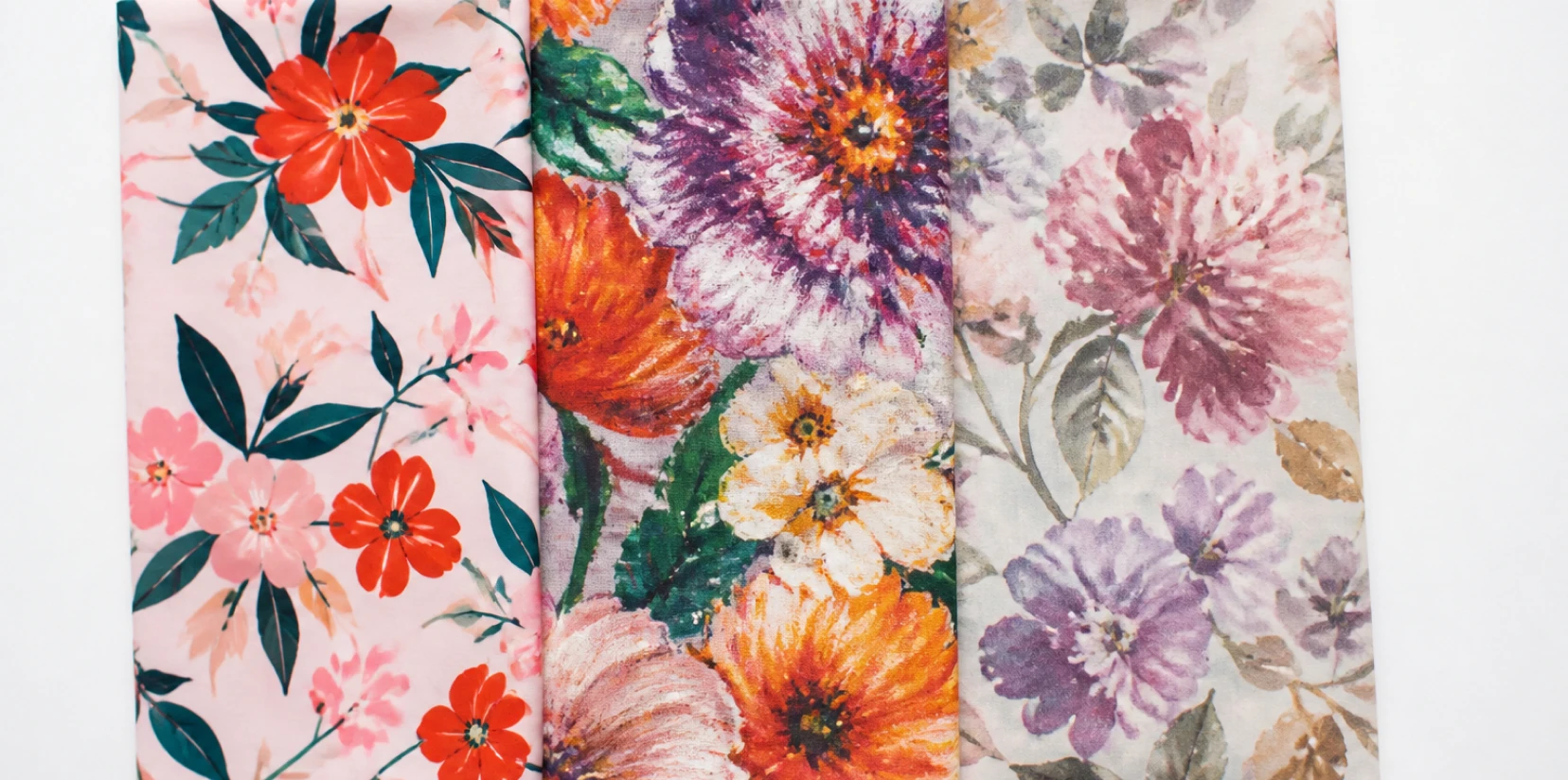
Three technical points separate professional execution from commodity output. First, polypropylene has low surface energy; the web must pass corona treatment above roughly 42 dynes before ink will bond permanently. Second, for gravure work the artwork is printed on BOPP film and then laminated to the nonwoven base, which puts the ink layer behind the film and makes it effectively immune to abrasion and fading. Third, artwork files should arrive as vector AI, EPS, or PDF with Pantone references. Supplying a low-resolution JPEG transfers your prepress cost into a guessing game. Our printed nonwoven bag programs run on 7-color gravure lines for exactly this reason.
、
6. Lamination and Finish Decisions
Lamination bonds a thin film to the nonwoven fabric surface and changes three properties at once: it makes the bag waterproof, increases rigidity and shape retention, and provides the smooth print surface required for photographic reproduction. The specification variables:
- Film and finish. BOPP in gloss for maximum color intensity, or matte for a softer premium hand. Matte also hides scuffing better across repeated use.
- Coverage. Single-side lamination is the standard retail construction; double-side lamination stiffens the bag further and protects the interior for food-adjacent or damp-duty use.
- Trade-off. Lamination adds cost and complicates end-of-life recycling streams. If the program is a short-lived giveaway, plain unlaminated fabric is usually the rational specification.
State the finish explicitly in the PO. "Laminated bag" without a finish callout will come back gloss by default at most factories.
7. Sampling, Verification, and Quality Documentation
A specification is only as good as its verification. The procurement sequence that prevents disputes:
- Pre-production sample. Approve a physical sample against the full written spec—GSM, dimensions, handle construction, print, finish. Photographs are not a substitute; 60gsm and 80gsm look identical on screen.
- GSM verification. Nominal GSM drift is a known cost-cutting lever. Request the fabric test report and weigh-cut a 10 × 10 cm swatch from the production sample if the program is large.
- Batch documentation. For retail programs, require lab reports covering fabric weight, tensile strength, and color fastness, plus a pre-shipment inspection confirming dimensions, print registration, and carton count before container loading.
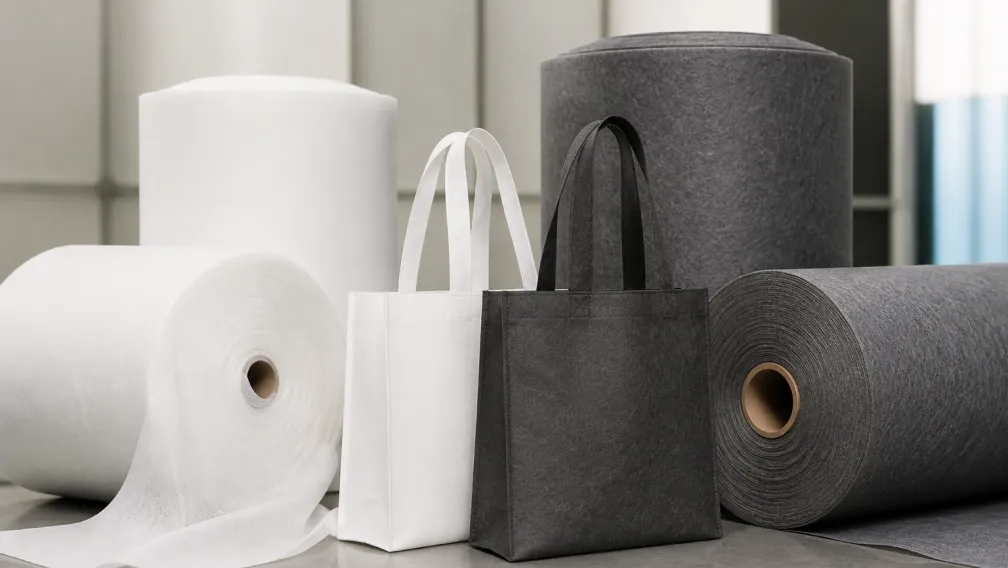
Buyers sourcing fabric separately for their own converting operations can review roll-level parameters in our nonwoven fabric rolls range and the accompanying technical specifications reference.
8. Regulatory Context for Reusable Bag Programs
Jurisdictions that restrict single-use plastic bags increasingly define what qualifies as a reusable substitute, typically through durability and reuse-count expectations. Requirements differ by country and, in some markets, by state or province, and they are revised frequently. The procurement implication is straightforward: confirm the current rules in your destination market at the quoting stage, and spec fabric weight and seam construction to clear the local durability threshold with margin. A bag that fails compliance after production is a total write-off, not a discount negotiation.
Conclusion
Procurement of custom nonwoven bags is a specification exercise. Buyers who document application, GSM, architecture, handle and seam construction, printing method, and finish before requesting quotations receive comparable quotes, predictable quality, and far fewer disputes. Buyers who specify loosely receive the cheapest interpretation of their order. Send us your load profile, dimensions, and artwork, and our engineering team will return a written specification, a physical sample within 5–7 days, and batch test documentation on request. Contact our team to scope your program.