
Introduction: Regulation Is Now a Product Specification
Retail procurement teams sourcing reusable nonwoven bags now face two questions that did not exist a decade ago. First: is this bag legal to distribute in my destination markets? Second: does it actually deliver the environmental benefit the legislation assumes? Both questions have precise answers. Regulators in the US and elsewhere no longer ban single-use bags and leave the substitute undefined—they write durability, capacity, and labeling requirements directly into law. And a decade of published lifecycle assessments now quantifies exactly how many uses a reusable bag needs to outperform the bag it replaces. This guide consolidates both bodies of knowledge into a procurement framework.
1. How Regulators Define "Reusable"
Modern bag legislation converges on a common durability architecture, built around a defined number of uses under a defined load. The core clauses buyers should recognize:
| Jurisdiction | Durability Clause | Material Clause | Other Requirements |
|---|---|---|---|
| New York (6 NYCRR Part 351) | Minimum 125 uses; one use = carrying 22 lbs over 175 feet | Minimum 80gsm for non-film plastics including nonwoven PP and PET | Washable; non-stretching strap or handle |
| New Jersey | Designed for at least 125 reuses | PP or PET nonwoven fabric, nylon, cloth, hemp, or similar fabric | Stitched handles (thread or ultrasonic); plastic checkout bags banned regardless of thickness |
| California (SB 270 framework) | Designed for at least 125 uses | Third-party certified; bag producers renew certification every two years | Minimum 15-liter capacity; machine washable or cleanable; manufacturer name, country, and 125-use statement printed on the bag |
Read as a specification, these laws describe a product: 80gsm or heavier fabric, mechanically fastened handles, washable construction, and certified durability. That is precisely the construction class of a properly built nonwoven PP tote—and precisely what a lightweight giveaway bag is not. The regulatory trend line points in one direction: durability thresholds are being written down, tested, and enforced, so the gap between a compliant reusable bag and a cheap promotional bag is now a legal distinction, not a quality preference.
2. The California Shift: Film Is Out, Textile Is In
California illustrates where regulation is heading. The original SB 270 banned thin single-use bags while permitting thicker plastic film bags—2.25 mils minimum with 40% post-consumer recycled content—as certified reusables. Field data showed consumers rarely reused them and recycling infrastructure could not process them. Senate Bill 1053 closed that carve-out: since January 1, 2026, stores in scope may not distribute any plastic carryout bag at the point of sale, regardless of thickness. Paper bags remain available at a minimum ten-cent charge with rising recycled-content requirements (40% post-consumer, moving to 50% from 2028).
The decisive detail for procurement: nonwoven PP is a textile, not a film. The 2.25-mil and PCR clauses that govern plastic film bags do not apply to stitched nonwoven totes, which qualify under the durable-material provisions alongside cloth and PET fabric bags. Washington State's trajectory confirms the pattern—its film thickness requirement steps from 2.25 to 4 mils in 2026, tightening film while leaving fabric reusables untouched. For multi-state retailers, a certified stitched-handle nonwoven tote is the specification with the longest regulatory shelf life.
3. Labeling and Certification Duties
Compliance attaches to paperwork as much as to the bag itself. Under California's framework, reusable bag producers must be certified by a third-party body (an ISO/IEC 17025 laboratory or ISO/IEC 17065 certification body), listed by CalRecycle, and recertified every two years. The bag must carry printed on it the manufacturer's name and country, a statement that it is a reusable bag designed for at least 125 uses, and recycling instructions where applicable. New York's rule requires equivalent durability evidence, and several jurisdictions reference washability explicitly.
The procurement implication is direct: labeling and certification language belongs in the purchase order, not in an email after production. Artwork layouts should reserve permanent print area for the compliance statements, and the supplier should be contractually responsible for delivering the durability test documentation that certification requires. For the full specification workflow, see our custom nonwoven bag specification framework.
4. The Lifecycle Arithmetic
A reusable bag consumes more material and energy to produce than a 7-gram HDPE checkout bag, so it starts its life in environmental debt. The question every LCA answers is how many uses retire that debt. The major published studies:
| Study | Nonwoven PP | Cotton | Scope Note |
|---|---|---|---|
| UK Environment Agency (2011) | ~11 uses | ~131 uses | Global warming potential; single-use bag reused as bin liner 40% of the time |
| Danish EPA (2018) | ~52 uses | ~7,100 (conv.) / 20,000 (organic) | All impact categories aggregated, including litter |
| Quebec CIRAIG (2017) | 11–59 uses | 100–2,954 uses | Range reflects indicator and shopping scenario |
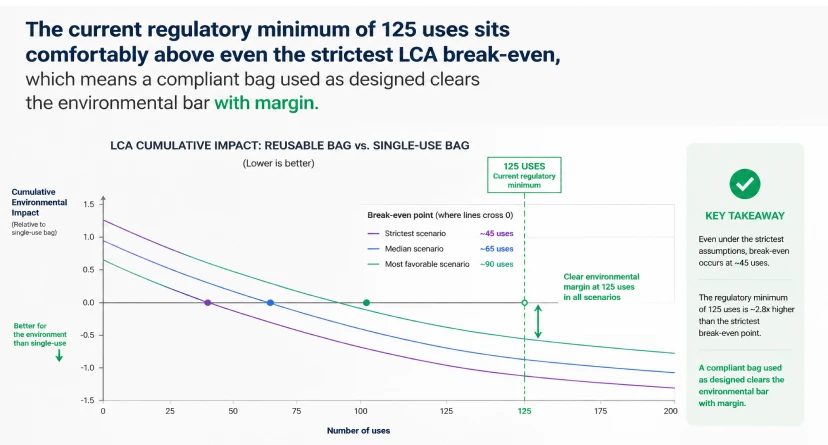
The numbers differ because methodologies differ—impact categories counted, end-of-life credits, and capacity assumptions all move the result. Three conclusions survive every study. Nonwoven PP carries the lowest break-even of any reusable material in every analysis. Cotton's production footprint is so heavy that its break-even sits beyond realistic consumer behavior. And the single variable that determines whether any reusable bag pays back is the reuse rate actually achieved—which is a design outcome. Bags that survive washing, carry printed branding that stays legible, and feel worth keeping get reused; flimsy giveaway bags enter the waste stream before their debt is retired. The current regulatory minimum of 125 uses sits comfortably above even the strictest LCA break-even, which means a compliant bag used as designed clears the environmental bar with margin.
5. Program Design Determines the Reuse Rate
The lifecycle math only works if customers actually reuse the bag, and reuse rate is set by how the bag enters the customer's hands. The three distribution models behave differently. Bags sold at checkout at a nominal price ($1–3) filter for customers who intend to reuse—the act of paying assigns the bag value, and retailers frequently recover the unit cost within the first quarter. Threshold gifts ("spend $50, receive a bag") drive basket size and put the bag into committed customers' hands, with the cost absorbed into the promotional budget. Loyalty-program inclusion targets the highest-frequency shoppers, who generate the most reuse cycles per bag. The model to avoid is indiscriminate free distribution: bags handed out without commitment accumulate unused in closets, and a reusable bag used twice is environmentally worse than the single-use bag it replaced. Volume planning should follow the same logic—a smaller run of well-built, well-distributed bags outperforms a larger run of disposable-quality ones on both the compliance and the lifecycle ledger.
6. Specifying for Compliance and Lifecycle Performance Together
The compliance clauses and the lifecycle findings point to the same specification:
- Fabric weight: 80–100gsm as the regulatory floor; 100gsm or laminated constructions where a multi-year service life is the program goal.
- Handles: Stitched (thread or ultrasonic) attachment is an explicit requirement in New Jersey-style language; sewn webbing with reinforced attachment survives the washing cycles that washability clauses imply.
- Washability: Specify it as a test condition: the bag, including print, should survive repeated machine or hand washing without structural failure or graphic degradation. Gravure-printed BOPP laminated constructions seal the ink layer behind film, which is why printed laminated bags hold branding through wash cycles that destroy surface silkscreen.
- Labeling: Reserve print area for manufacturer identification, country of origin, and the 125-use statement required in California-style frameworks.
- Documentation: Require durability test evidence (load cycling at the regulated weight and distance), material test reports, and any third-party certification your destination market lists.
Conclusion
Reusable bag procurement is now a compliance exercise with a lifecycle audit attached. Regulators define reusable through quantified durability—125 uses, 80gsm, stitched handles, washable construction—and lifecycle research independently confirms that nonwoven PP reaches environmental break-even faster than any alternative reusable material, provided the bag is built well enough to be kept and reused. A correctly specified nonwoven program satisfies both tests at once. Send us your destination markets and program volumes, and our team will return a compliant specification with durability documentation and print layouts that accommodate mandatory labeling. Contact our team to scope your program.