
Introduction: One Platform, Two Product Families
Agricultural buyers encounter nonwoven polypropylene in two forms that share almost nothing except the polymer: lightweight floating row covers that sit above the crop, and heavy ground-cover fabrics that sit on the soil. Both are spunbond PP, yet they are specified on opposite logic—row covers are engineered to transmit light, while weed barriers are engineered to block it. Confusing the two families, or specifying within them by price alone, is the most common sourcing error we see from farm-supply distributors and commercial growers. This guide sets out the specification framework for both, based on university extension data and production practice. For the underlying material parameters, our PP spunbond technical specifications reference covers fiber architecture and test methods in detail.
1. Floating Row Covers: How a 20-Gram Fabric Changes a Microclimate
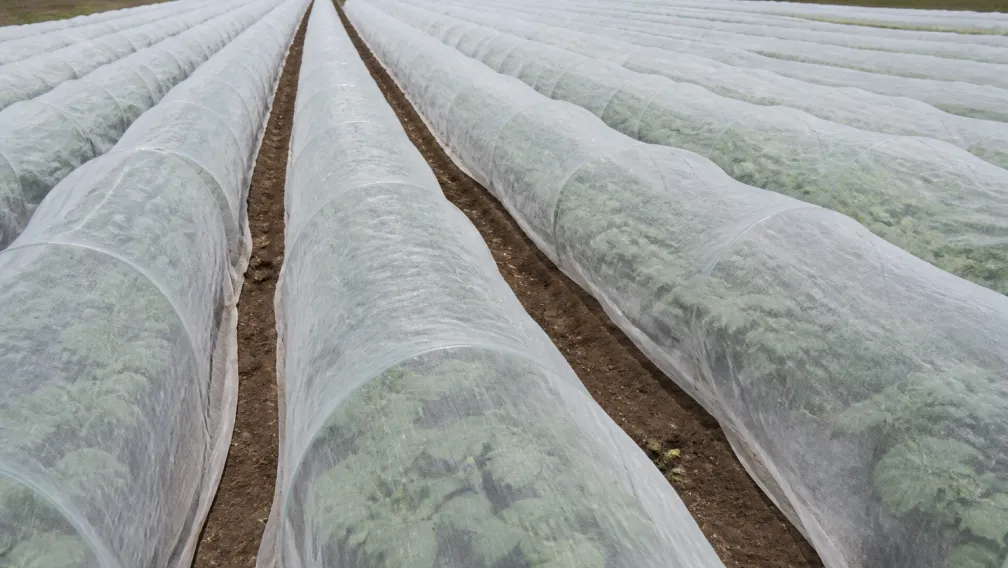
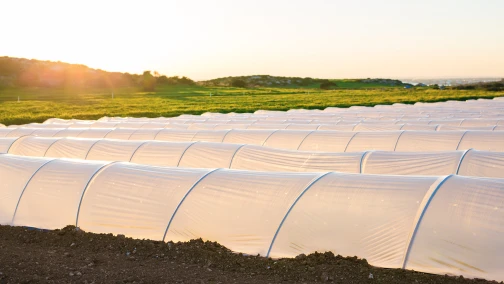
A floating row cover is a porous spunbond web laid directly over crops or supported on low hoops. Its value comes from selective permeability: sunlight, rain, and air pass through the filament matrix, while the web traps a boundary layer of warm air at night and physically excludes insects, birds, and wind-blown debris by day. The result is a measurable microclimate effect—soil warms earlier in spring, germination accelerates, frost damage is deferred, and pest pressure drops without chemical intervention. Extension research across US land-grant universities consistently documents earlier harvests and higher marketable yield under covers, which is why row covers remain standard equipment in commercial vegetable production despite being one of the cheapest inputs on the farm.
2. GSM Classes: The Row Cover Specification Table
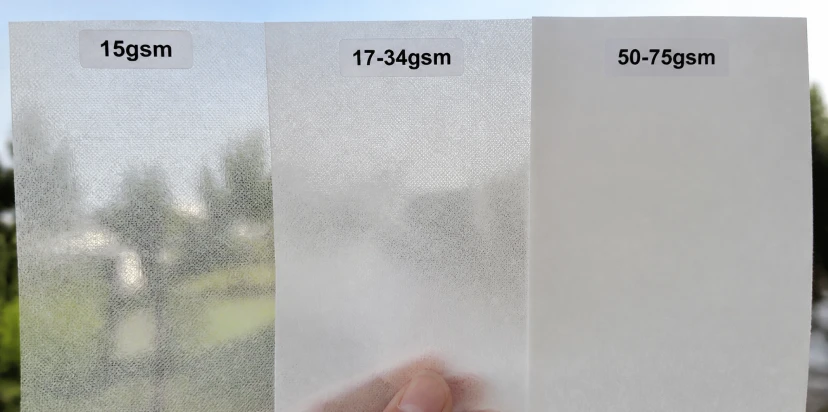
Row cover selection is a three-way trade-off among light transmission, frost protection, and durability. University extension guides converge on the following classes:
| Class | Weight | Light Transmission | Frost Protection | Typical Duty | Service Life |
|---|---|---|---|---|---|
| Lightweight | ~15gsm (0.45 oz/yd²) | 90–95% | ~1°C (2°F) | Insect barrier, season-long pest exclusion | One season, two with careful handling |
| Medium | 17–34gsm (0.5–1.0 oz/yd²) | 70–85% | 2–3°C (4–6°F) | Spring/fall frost protection, season extension | Two to three seasons |
| Heavyweight | 50–75gsm (1.5–2.2 oz/yd²) | 30–50% | Up to 4°C (8°F) | Overwintering, harsh-climate protection | Several seasons |
Two implications deserve emphasis. First, heavier is not universally better: every step up in GSM buys frost margin at the cost of light, and light is yield. A heavy cover on a light-hungry crop in a mild climate produces leggy, low-quality growth. Second, the durability column explains the economics—at 15gsm the fabric is essentially disposable, while 30gsm-plus constructions survive removal, cleaning, and storage across multiple seasons, changing the per-season cost calculation entirely.
3. Deployment Discipline
Field results depend as much on handling as on fabric specification. The practices that separate successful programs from damaged crops:
- Support tender crops: Lettuce, brassicas, onions, and strawberries tolerate a floating cover resting on the foliage. Tomatoes, peppers, and cucurbits have exposed growing points that wind abrasion will destroy; use wire or PVC hoops at 3–6 foot intervals.
- Seal the edges with soil, not stakes: A loose edge lets pests walk under the barrier and lets wind lift the sheet. Soil berms or sandbags are the reliable anchors; pins and staples tear the web.
- Vent or remove above 80°F (27°C): Heat builds fast under a cover on warm days, and overheating damages crops faster than the frost the cover was bought to prevent. When insect exclusion is still needed in hot weather, mesh netting is the correct substitute.
- Lift covers for pollination: Crops that set fruit through insect pollination—squash, cucumbers, melons—must be uncovered at flowering, or hand-pollinated.
- Store dark, dry, and clean: UV exposure in storage degrades PP as surely as UV in the field. Covers folded dry and bagged in black film between seasons routinely double their rated service life.
4. Weed Barriers and Landscape Fabric: The Ground-Cover Family
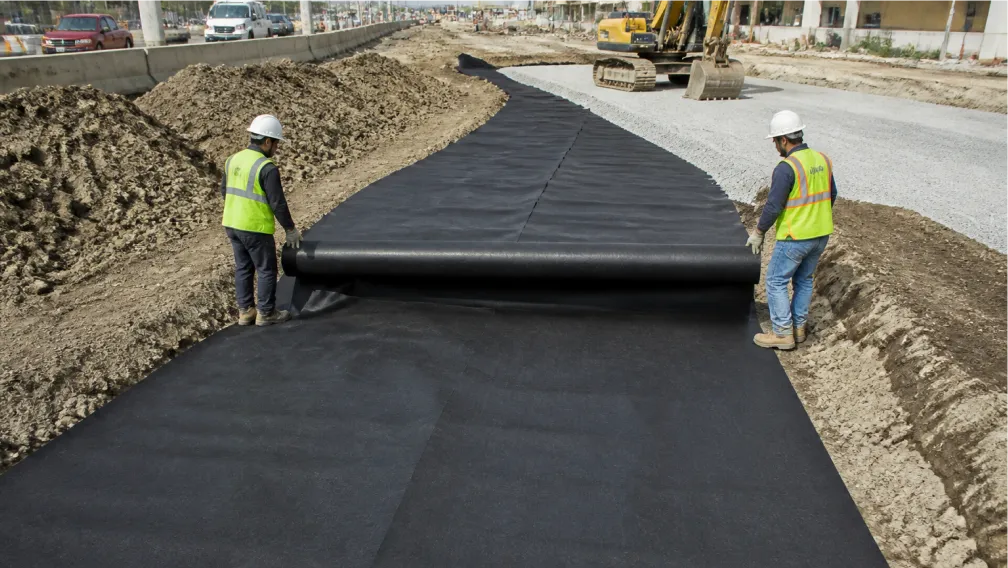
Ground-cover fabrics invert the row-cover logic. The specification goal is light exclusion: a black or dark-green nonwoven landscape fabric at 70–135gsm blocks photosynthesis at the soil surface while remaining permeable to water, air, and liquid fertilizer. Commercial grades are UV-stabilized (typically a 3% UV masterbatch package) and carry rated lifespans of 5, 12, or 20 years depending on construction and exposure.
Buyers face two structural choices within the family:
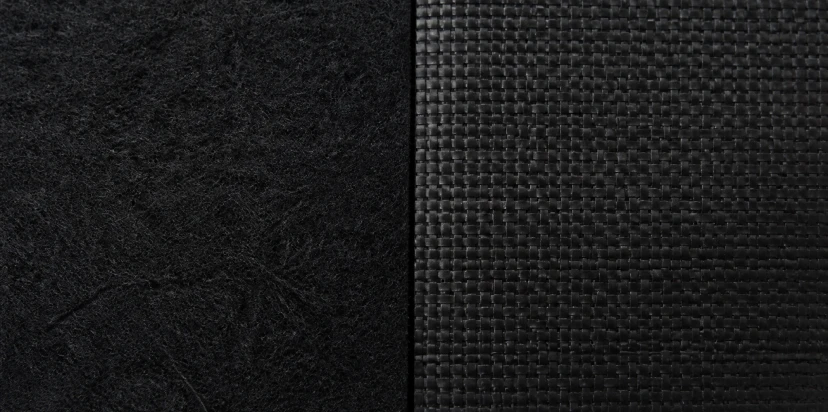
| Factor | Nonwoven (Spunbond / Needle-Punched) | Woven (Slit-Film PP) |
|---|---|---|
| Texture | Felt-like, conforms to ground contour | Tarp-like, stiffer |
| Water permeability | High; suited to beds and drainage-critical sites | Low; water runs along the surface |
| Tear and tensile strength | Moderate | High |
| Best-fit applications | Planting beds, under mulch, erosion-prone slopes, drainage layers | Under gravel and rock, driveways, high-traffic paths, long-term static cover |
Against black plastic mulch, the comparison is one of longevity: plastic film blocks nearly all weeds for a single season, then tears, degrades, and becomes disposal waste. A UV-stabilized fabric barrier suppresses the large majority of weeds for multiple years without annual removal and re-laying, which is why fabric has displaced film in perennial beds, orchards, and landscaping. For heavier civil-engineering duty—separation and filtration under load—the product class shifts to geotextile constructions, which follow different test standards entirely.
5. Specification and Procurement for Distributors
Agricultural nonwovens are sold by the roll, and five parameters define a defensible quotation:
- GSM with tolerance: State the class and hold tolerance to ±1–2gsm; underweight fabric is the standard cost-cutting lever in this market.
- UV package and lifespan claim: Specify the stabilization percentage and require the rated outdoor lifespan to appear in writing. Quality lines use branded UV masterbatch and can support the claim with accelerated aging data.
- Light transmission or light blocking: For row covers, transmission percentage; for weed barriers, opacity. Both are measurable and both belong on the datasheet.
- Width and roll format: Commercial spunbond lines produce widths to 3.2m and beyond with reinforced, optionally color-lined edges; wider rolls reduce buried-edge labor per covered hectare. Roll length, core diameter, and splice policy should be stated for retail repacking programs.
- Finishing options: Hydrophilic treatment for weed barriers improves water infiltration in dry climates; anti-UV, color, and printed planting guides are standard customization levers for private-label garden brands.
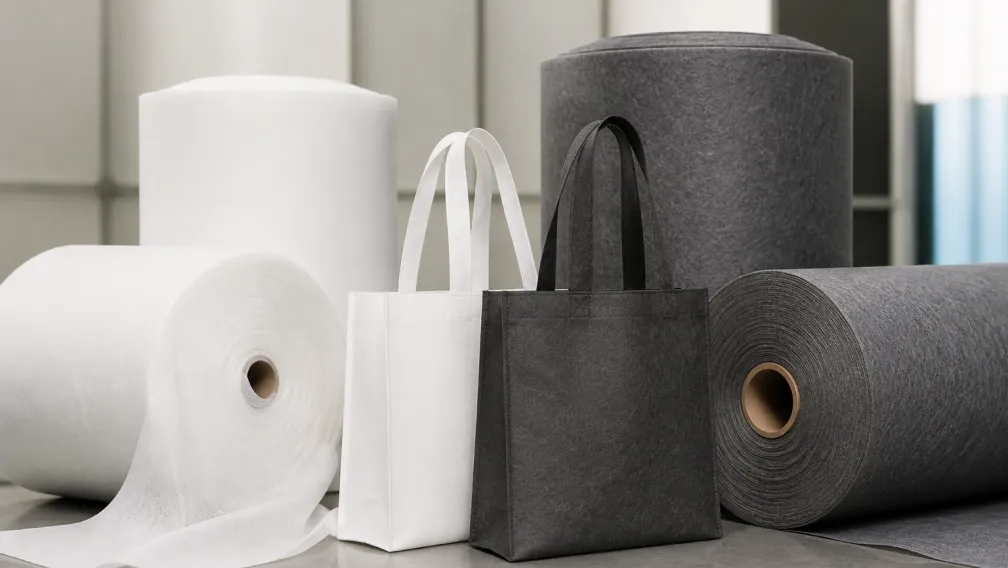
Distributors building private-label lines should note that roll-level converting—width slitting, length conversion, printed retail sleeves, barcode labeling—is a standard OEM service. Programs can be quoted as bulk jumbo rolls for industrial agriculture or as shelf-ready retail units from the same extrusion run, which keeps fabric consistency across both channels. Bulk roll parameters are covered in our fabric rolls range.
6. Material Quality Variables the Datasheet Hides
Two rolls quoted at identical GSM and identical width can behave very differently across a season, and the differences trace back to three production variables. The first is resin grade. Fabric extruded from certified virgin PP with a branded UV masterbatch holds its tensile strength through the season; fabric stretched with excessive filler or unstated recycled content embrittles early, and the failure arrives as wind tearing in month three rather than as a visible defect on delivery day. The second is web uniformity. Spunbond webs are laid aerodynamically, and poorly controlled lines produce thick and thin lanes across the width; in a row cover those thin lanes are where hail and deer damage start, and in a weed barrier they are where light leaks through. Reputable mills monitor basis weight continuously and hold tolerance across the full width. The third is edge construction. Covers and barriers fail first at the edges where anchoring stress concentrates; reinforced or double-bonded edges are a small cost premium that removes the most common tear-initiation point. Buyers should ask for a full-width sample rather than a cut swatch, because a swatch from the center of the web proves nothing about the edges.
Conclusion
Agricultural nonwoven sourcing reduces to two specification exercises. Row covers trade light against frost margin across three GSM classes, with deployment discipline—support, sealing, ventilation, storage—determining realized value. Weed barriers trade permeability against strength between nonwoven and woven constructions, with UV stabilization setting the service life. Buyers who specify GSM tolerance, light performance, and the UV package in writing receive fabric that performs as quoted. Send us your crop program, climate zone, and target widths, and our team will return a written specification with samples. Contact our technical team to scope your order.