
Introduction: An Engineered Material, Not a Garden Product
Buyers regularly confuse geotextile fabric with landscape weed barrier because both are sold as rolls of black synthetic cloth. The distinction is load-bearing: a geotextile is an engineered material with rated, testable properties—tensile strength, permittivity, opening size—specified against soil conditions and verified against ASTM standards. A weed barrier is a horticultural convenience product with none of that documentation. This guide covers the nonwoven side of the geotextile family: what the fabric does mechanically and hydraulically underground, how the weight classes map to applications and soil types, and which numbers on a datasheet actually decide field performance over a multi-decade design life. Landscape-grade products are a separate specification covered in our agricultural fabric guide.
1. The Five Functions
Every geotextile application reduces to one or more of five functions, and the specification follows from which function dominates:
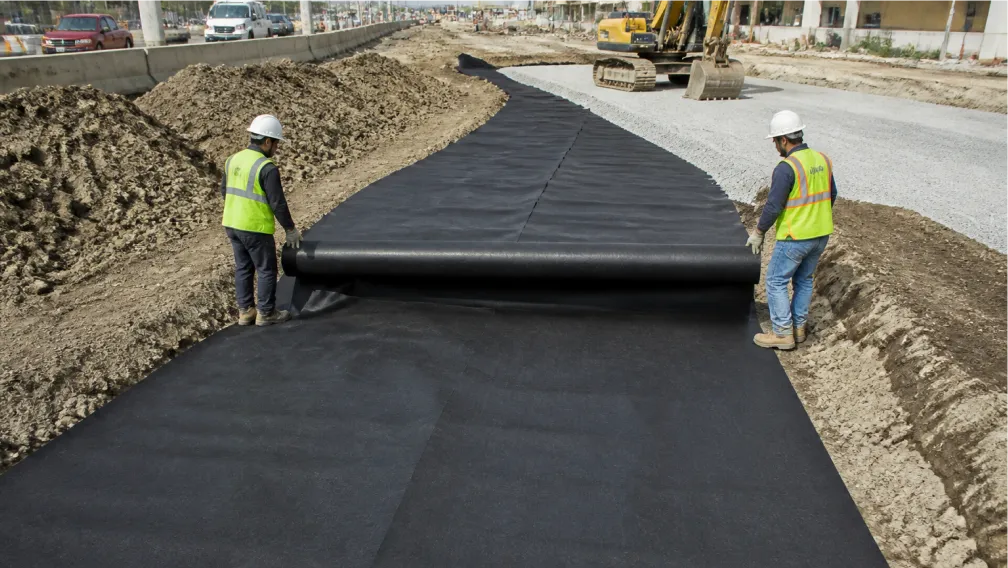
- Separation: the fabric prevents intermixing between subgrade soil and base aggregate. Without it, aggregate punches into soft soil under traffic and the structure loses thickness; with it, documented installations show aggregate loss falling by roughly a quarter and pavement structures holding integrity across a fifteen-year design cycle.
- Filtration: the fabric passes water while retaining soil particles. This is the defining nonwoven strength—the three-dimensional fiber matrix acts as a depth filter rather than a screen.
- Drainage: water moves through and within the fabric plane, relieving hydrostatic pressure behind retaining walls and carrying flow in trench drains.
- Protection: the fabric cushions geomembrane liners in landfills and ponds against puncture from angular aggregate and compaction stress.
- Erosion control: under riprap and on slopes, the fabric holds the soil profile while allowing seepage, preventing the undermining that fails armored banks.
2. Nonwoven or Woven: The First Decision
The two constructions are not interchangeable grades of one product; they are different engineering materials. Published comparative data gives the working picture:
| Property | Needle-Punched Nonwoven | Woven (Slit-Film / Monofilament) |
|---|---|---|
| Wide-width tensile (ASTM D4595) | 5–30 kN/m | 20–200 kN/m |
| Elongation at break | 50–100% | 5–25% |
| Permittivity (ASTM D4491) | 0.5–2.0 s⁻¹ | 0.01–0.5 s⁻¹ |
| Apparent opening size (ASTM D4751) | 0.15–0.42 mm | 0.25–0.85 mm |
| Grab strength (ASTM D4632) | 200–900 N | 500–3,000 N |
| Thickness | 1.5–5 mm, conformable | Thin, stiff |
The selection rule is functional. Where water must move—French drains, retaining-wall backfill, leach fields, riprap underlayment—the nonwoven's 5-to-50-fold permittivity advantage and finer soil retention make it the correct material. Where the fabric is the structure—reinforcement of very soft subgrades, MSE walls, high embankments—the woven's high modulus and low elongation carry the load, and a nonwoven will creep and elongate past its design intent. Specifying "geotextile, 200 gsm" without designating the construction is a documented failure mode: suppliers have delivered nonwoven where woven reinforcement was assumed, with wall deformation as the result.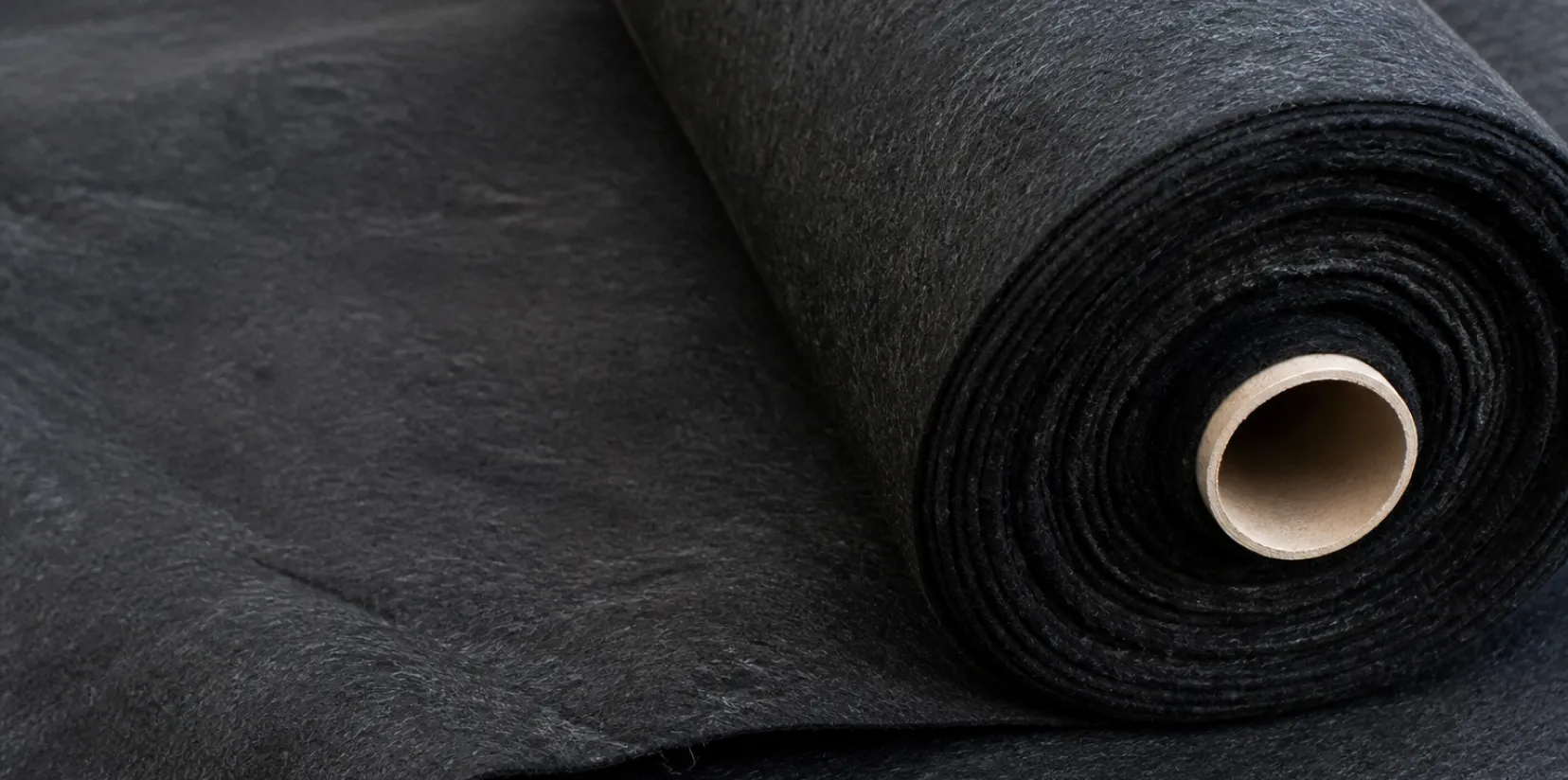
3. Within Nonwovens: Needle-Punched vs. Thermally Bonded Spunbond
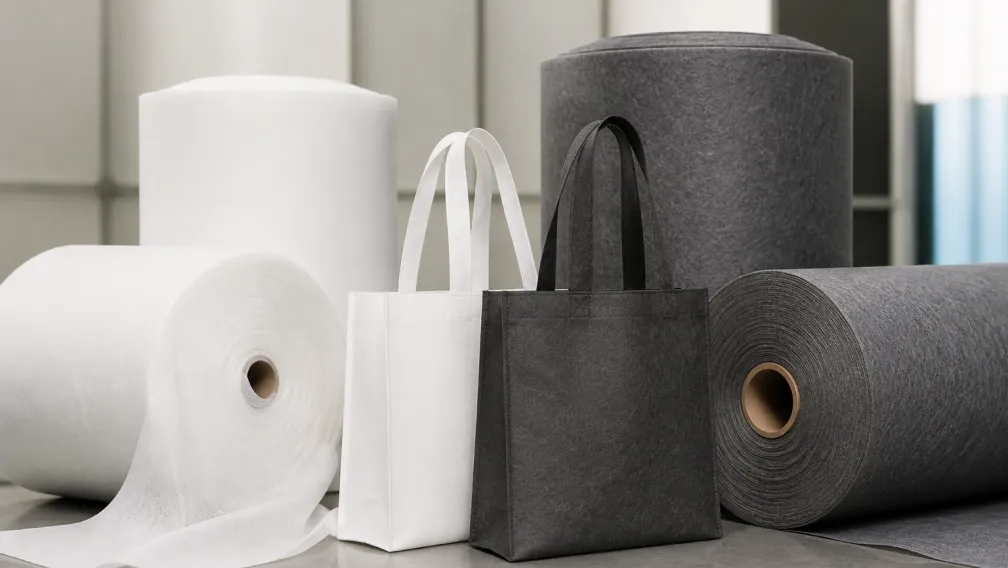
The nonwoven family itself splits two ways. Needle-punched fabric interlocks staple or continuous fibers mechanically through thousands of barbed-needle penetrations per square meter; thermally bonded spunbond fuses continuous filaments at calender points. For hydraulic duty the difference is measurable:
| Parameter | Needle-Punched | Thermally Bonded Spunbond |
|---|---|---|
| Porosity | 85–93% | 55–72% |
| Permittivity (ASTM D4491) | 1.2–3.5 s⁻¹ | 0.2–0.7 s⁻¹ |
| Thickness (ASTM D5199) | 2.2–4.8 mm | 0.3–0.6 mm |
| CBR puncture (ASTM D6241) | 1,600–4,800 N | 800–2,100 N |
| Gradient ratio (ASTM D5101) | 1.0–1.4 (stable, low clogging risk) | 2.8–4.5 (elevated clogging risk) |
The gradient ratio row deserves attention because it predicts long-term behavior rather than day-one performance: values above roughly 3 indicate the fabric is trapping fines internally and clogging. For permanent drainage and filtration, needle-punched construction is the defensible specification. Thermally bonded spunbond retains a role where a smooth, uniform surface matters—geomembrane protection layers, separation under light loads, and composite laminations where the geotextile is one ply of a multi-material product. Our nonwoven geotextile range covers both constructions, and the PP spunbond fabric technical reference explains the thermal-bonding platform in detail.
4. Weight Classes and Application Mapping
In commercial channels, nonwoven geotextile is quoted in ounces per square yard (1 oz/yd² ≈ 34 gsm). The standard mapping:
| Weight | Approx. GSM | Typical Applications |
|---|---|---|
| 3 oz | ~100 | Light filtration, drain-pipe sock wrap, sandy soils |
| 4 oz | ~135 | French drains in sandy or loamy soil, dry wells, retaining-wall drainage; the most common residential weight |
| 6 oz | ~200 | Clay-heavy soils, high-silt drainage, leach fields, commercial drainage |
| 8 oz | ~270 | DOT drainage, high-silt environments, heavy-duty filtration |
| 10–16 oz | ~340–540 | Geomembrane cushioning, landfill protection layers, erosion control under heavy riprap |
Two field rules accompany the table. Soil type moves the weight selection: sandy and loamy soils drain well through 4 oz, while clay and silt demand 6 oz or heavier because finer particles clog a light fabric's pores. And heavier is not automatically safer in filtration duty—an 8 oz fabric in clean sand can restrict flow unnecessarily and adds cost per square meter without adding function.
5. The Datasheet Rows That Decide Performance
A geotextile datasheet contains a dozen rows; six of them do the work:
- Grab tensile strength (ASTM D4632): installation survivability. AASHTO M288 sets minimums by class—Class 1 for severe installation stress, Class 2 as the default, Class 3 for mild conditions—with the numerical threshold depending on elongation (for example, Class 1 requires 1,400 N for low-elongation fabrics and 900 N for fabrics at 50% or greater elongation).
- CBR puncture (ASTM D6241): resistance to angular aggregate. This is the number that predicts damage during stone placement.
- Permittivity (ASTM D4491): cross-plane flow capacity. Minimums step down with soil fines content—0.5 s⁻¹ for clean granular soils, 0.1 s⁻¹ where more than half the soil passes the 0.075 mm sieve.
- Apparent opening size (ASTM D4751): the largest soil particle the fabric passes. Match AOS to the site's D85; 0.212 mm (No. 70 sieve) intercepts over 90% of particles in fine sand and silt.
- Gradient ratio (ASTM D5101): long-term clogging behavior. Specify below 3 for permanent filtration.
- UV stability (ASTM D4355): 50% strength retention after 500 hours is the standard minimum; fabric left exposed beyond 30 days on site needs a heavier UV package regardless of what the datasheet's baseline says.
Values should be quoted as MARV—minimum average roll values—rather than typicals. A typical value describes the average roll; a MARV defines the weakest roll you can receive, which is the only number a specification can enforce.
Verification instruments are standard and inexpensive relative to project risk. Require the manufacturer's test reports against each specified ASTM method, confirm the values are MARV, and for municipal or DOT work confirm NTPEP or equivalent third-party evaluation where the specification calls for it. For distributor stocking programs, retain a reference sample from each incoming lot and check mass per unit area (ASTM D5261) and thickness on receipt; both are five-minute tests that catch underweight fabric before it reaches a job site.
6. Installation Variables That Override the Specification
Field failures usually trace to handling rather than material. Overlaps should run 12–18 inches and increase on soft ground; seams that gap under construction traffic recreate the intermixing the fabric was bought to prevent. Aggregate should be end-dumped onto placed stone rather than directly onto fabric from height, because drop impact, not static load, is what punctures. And the UV clock starts at unwrapping: standard PP fabric should be covered within 30 days, since unstabilized polypropylene loses measurable strength through a single exposed season. These points belong in the installation method statement, and for distributor programs they belong on the roll label as printed handling instructions.
Conclusion
Nonwoven geotextile selection is a function-first exercise: identify whether the job is separation, filtration, drainage, protection, or erosion control; choose construction accordingly—nonwoven for hydraulic duty, woven for reinforcement, needle-punched over thermally bonded where clogging resistance matters; then fix weight, AOS, permittivity, and puncture values against the site's soil data, quoted as MARV. Send us your application, soil conditions, and roll format requirements, and our team will return a written specification with test documentation. Contact our technical team to scope your program.